2015 = Streamline

On the ever-wise Facebook last week, I saw a meme going around–What is your word for 2015? Nothing popped out at me in any clarifying ah-ha! moment. 2014 was a crazy, tragic, yet wonderful year. It started out with major upheaval for my beloved Hadley Rille Books, upheaval that had me scrambling to figure out how to run a small press when I didn’t even have passwords for any of the accounts. With the help of my Hadley Rille Books family, and the associated entities we work with, I figured it out. WE figured it out, and held the fort quite competently.

During that time of upheavalishly figuring things out, my life was consumed with all things HRB. I needed something outside of it, and so wrote my first contemporary romantic fiction. It was nothing short of breathtaking–magical, even. I started Seeking Carolina in February, finished it in May, and sold it in June (to Lyrical, the newest imprint of Kensington Publishing.) I’ve since written another book for the series, and am at work on yet a third. Let’s hope Lyrical wants them!

2014 also saw my son’s ongoing medical issues get worse, and then infinitely better. Infinitely. After years of life-saving but mind-numbing medication, he is coming off all of them one at a time, and his amazing personality and brilliant mind are finally freed. It is a daily joy, seeing him be HIM, in ways he hasn’t been able to be in almost ten years.

2014 was a year of being responsible for things outside my own, personal world. Between Hadley Rille Books and my son’s medical stuff, I’ve dedicated a good portion of my time. Combine that with my writing group, my reading group and my family at large, and it’s amazing that I’ve gotten as much writing done as I have. But it’s all a bit of a blur. Sheer will got it done. 2015 is going to be different. I don’t want to force myself though my life. I want to experience it.

imagesD9LE67W1

So I’m streamlining. That’s my word for the year. Streamline. With my stint at running a small press no longer a necessity, I’m going to back off and let the pieces fall together in whatever fashion they will. I am editing two books this year, no more. Editing, not producing and getting out to press. If my book club chooses a book I really have no interest in reading, I’m not going to read it. This, “I must read all book club books” mentality has to go. It’s keeping me from the many books I have been dying to read. Life is too short, and reading time too limited, to waste on stuff that doesn’t tickle my fancy.

I am going to learn the word “No,” and hold it as precious as I do “Modesty is for suckers.” I am going to stop being the mom of every group I encounter. I am going to streamline my life so that I can be IN it instead of flying somewhere above it, hoping to catch up. Call this my resolution, call it my goal; whatever it is–streamline–it’s my word for 2015. What’s yours?

21 Comments

Filed under Writing is Life

Taking a Stand

Twice last week, friends alerted me to the Jodi Picoult article on Jezebel in which the fabulous lady lamented:

…Despite this success – 23 novels in 22 years, eight of which have been number one on the New York Times bestseller list – she struggles to be taken seriously. “I write women’s fiction,” she says, an ‘apparently’ hanging in the air. “And women’s fiction doesn’t mean that’s your audience. Unfortunately, it means you have lady parts.

Women’s fiction. What the fuck does that even mean? No, really. Does it mean literature for women? By women? Why does it need the “women’s” part added on, like a nurse who happens to be a man is always a “male nurse” and not just a nurse? Marketing, schmarketing. It perpetuates the notion that it’s something lesser. Ms. Picoult’s, The Storyteller is certaintly not “women’s fiction” any more than Lief Enger’s, Peace Like a River is YA or Nelson DeMille’s, Gold Coast is “men’s literature.” Oh, right–books written by men don’t get a designation. Men can write books about men, about women, about children with points-of-view from any or all and it’s just literature. A woman writes a book with a female protag and it’s automatically women’s fiction (or the dreaded “chick lit.”) If she writes a male point of view character, she generally writes under her initials, like the amazingly talented and recently lamented PD James. THEN it can be literature without the “women’s” tagged on.

I know there are exceptions, and I look forward to having them listed in comments. Atlas Shrugged, by Ayn Rand comes to mind, and yet when I began listing authors like Margaret Atwood and Barbara Kingsolver, I had to wonder if most of their titles would not be given the “women’s fiction” lable. But you know what–this is and is not the point of this post. What is my point?

heart2 <– That’s my point. I will admit, when I first latched on to the notion, it was funny to me on many levels. It still is. The more I embrace it, the more it is coming to mean to me. Why does the “women’s fiction or “chick lit” appellation bother amazing writers like Jodi Picoult? You know what I say to that?

Bring it on.

In my original post concerning this little button I had made, I quoted Eleanor Roosevelt–no one can make you feel inferior if you don’t let them. We are letting them, ladies. We are letting labels get under our skin and define what we do, and how we feel about it. You want to call my work “women’s fiction”? I’ll take that. I’ll own it. It’s an honor I am not going to feel lesser for and no one can make me. We have to stop buying into this. The labels stick and the connotation stands because we don’t embrace it as women, as female authors.

I do not advocate the “if you can’t beat them, join them,” mentality–ever; I do believe that if we allow the label “women’s fiction” to rankle, it’s always going to be seen as a lesser form of literature. Sometimes, to make a point, you have to go beyond debating rationally and do it up big–which is where “I write cliterature” comes in.

I have always felt that the best way to get a point across is with humor. People remember funny. It makes them think. “I write cliterature” is funny, but when shouted instead of giggled behind a hand, it says so much more.

18 Comments

Filed under Romance, Women's Issues

A Gendered Bathroom?

I found this today, at a doctor’s office…

bathroom

The bathroom is female? This is just the sort of grammar-dork thing that sticks in my craw, dagnabbit…and apparently makes me talk like a ninety-year-old hillbilly, or a pirate. Yar. But this is a perfect illustration of misuse, and overuse.

Let’s look at the misuse, first–female is an adjective. You have female pilots, female plants, female plugs. Female is supposed to be followed by a noun. So in this sense, the sign is saying the bathroom itself, is female. Where is its vagina? Its ovaries? Its sense of being female even if it has no such parts? Okay, okay–there is a common usage thing going on here, in that female is and can be used as a noun (not in MY book, but…) In that case, it would still need a possessive apostrophe S. Either females’ bathroom. Or, if it belonged to a single woman, female’s bathroom.

I get it. No one is going to mistake what it means. But really, it would have been just as easy–easier–to do it right.

Now how about the overuse–and this is a lesson we writers have to learn or be shunned–do we really need the symbol AND the words? Is no one going to get that it’s a ladies’ bathroom, considering the skirted stick-figure? There was no need to then clarify the pictograph. Erroneously. Less is best, especially when more ends up being not only wordy, but grammatically incorrect.

And that is my grammar-dork rant for the day. Feel free to fling peas at me in the cafeteria. I probably have it coming.

6 Comments

Filed under Grammar

Even An Editor Needs An Editor

I am a good editor. I know my stuff. If there is a grammar mistake, a typo, a plothole, a well-written but totally unnecessary infodump, a confused POV, I will see it. I will not spare you. It’s all about the story; a writer’s ego has no place in that. I encourage debate, and if an author argues with me, I will often give way. It is my belief that constructive criticism makes us think, and thinking is always a good thing, even if it makes the writer a little pissy. The author might see my point, or see her own point from a different angle. In the end, the story wins, and that’s the true goal.

One of the things I always tell my writers is that we write for those who are going to notice, not the readers who won’t. My own bête noire, the confusion of that and which, is actually a usage in flux, and has been for…ever. Though the rule never changes, the usage does. Currently, though the British English rule is the same as the American English rule, Brits use which almost exclusively in restrictive and non-restrictive clauses. (That and Which blog post.) It has been so in American English, and is actually making its way back into usage. I, however, will never okay that in any edit I do. It grates to the point of being able to spoil an otherwise good story for me, if used too often; and thus my contention–write for those who will notice.

Imagine my surprise when my editor at Lyrical (the fabulous Penny Jo Barber) pointed out to me that I was breaking my own rule.

Moving to the desk, she clicked at the keyboard until the article she needed popped up on the screen.

The rule, as I know it, says that the comma acts as a transition, an invisible “and then.” It’s how I learned it, how I’ve always written it, totally oblivious to the fact that for some, it’s as grating as that and which confusion is to me. Why? Because it is grammatically incorrect. The ING in moving is a continuous motion, and can’t be done while clicking at a keyboard. The way I’ve always done it is one of those new–in that it’s not new at all–usages that goes against an established rule.

Whether I agree or not, I’ll never do again, because for those who notice, like my editor, it can spoil the story. Instead, I’ll write something like:

She moved to the desk, clicked at the keyboard. The article she needed popped up onto the screen.

Whichever way it’s written, the reader gets the idea. The second way is not going to make those who would have noticed cringe. I could have argued, as I encourage my authors to do. I could have cited usage in flux. But why? I agree, completely. This is why even editors need editors. We might turn in cleaner copy, but we will always need that authoritative eye reminding us that we don’t know everything.

PS: There is a “cheat” to know whether your ING works or not. If you can insert “while” to the beginning of the sentence and it still makes sense, it works. If not, it doesn’t.

frex: Sipping the hot tea, she breathed in the fragrant steam. Correct!

          Sliding down the hillside, she got up, brushed herself off, and hurried on. Wrong!

Thank you, Penny!

6 Comments

Filed under Grammar

Own It

Way back in 2002, I went on my first-ever writers’ retreat. It was a posh thing on Bald Head Island, women only, thirty or older. Private chef. Full body massage. Golf carts! The experience changed my life, and brought me lifelong friends I cherish beyond words. I was the “star” of the week, bolstered and praised and made to feel like my day in the literary sun was right around the corner! It also happened to be the worst thing that happened to me as a fantasy writer.

Fantasy is a much-maligned genre. It rarely gets the respect it deserves. I cannot tell you how many people have said to me, “I just don’t get fantasy.” Truly, you can insert just about any genre fiction (especially those majorly populated by female writers) in there and the same could be said. I’m not going to go into that rant. For the purposes of this post, let’s just leave it at that.

After my Bald Head trip, I thought I was supposed to be writing women’s fiction. I struggled to accomodate, but my heart just wasn’t in it back then. Two more retreats on Bald Head turned into my yearly-week-of-writerly-bliss in Virginia Beach, with women met through that earlier experience. While down there, years later, one of the women said to me, “Why do you keep trying to write women’s fiction when it’s not in your heart. Give yourself permission to write fantasy.”

Wow, so simple! I did, and the next thing I knew, I was applying to a weeklong scifi/fan writers’s workshop. I got in. Again, my life was changed. Not only writers, but writers in MY genre! I’d found a tribe. And I’ve kept that tribe. Through the people I met there, I ended up with Hadley Rille Books.

Three novels with Hadley Rille Books later, I found myself in need of a change. There was a story itching under my skin, and my brain needed a step out of the world I was in. I remembered about giving myself permission, and I did. I gave myself permission to write romance.

Yes, romance. I used to cringe away from the moniker, but you know what? I’m not going to. As maligned as fantasy is, so too is romance. There is good romance, and there is bad romance. There is good and bad mystery/scifi/mainstream/anything! When my darling-man of an endocrinologist expressed an interest in my writing, I proudly told him I write both fantasy and romance. His wife is a romance-novel fiend.

“You know what she calls romance novels?” he asked. I waited. “Cliterature.”

Personally, I found that hilarious. I’ve heard from others that it’s a slur they do not appreciate, another way to marginalize a female-centric genre. You know what I say? Own it.

Eleanor Roosevelt, that paragon of amazing womanhood, once said, “No one can make you feel inferior without your consent.” Brilliant woman. Spot-freaking-on, then and now and forever more. Maybe cliterature was coined to marginalize. Maybe it was a clever rif. I’m not just owning it, I’m embracing it. I write romance, just like I write fantasy. No cringing. And if I can have a little fun with it, thumb my nose at those who look down on romance as the lowest rung on the literary ladder, even better. That’s why I had these buttons made…

heart2

I will be handing these out at the RWA convention in NYC next summer, to those brave and cheeky enough to wear them.

17 Comments

Filed under Women's Issues

A New Cover for Finder

When Finder was published in 2010, Eric Reynolds of Hadley Rille Books indulged me with my cover art. I said I didn’t want people, I wanted a landscape. After much going back and forth with Jesse Smolover, an extremely talented young man who happened to be longtime friends with my son-in-law, we decided on a gorgeous cityscape as well as a figure–Ethen–looking down on it. This is the result, and I adored it.

29146_600-2

original cover, by Jesse Smolover


I gave no thought to marketing, to my audience, only to my own aesthetic. What did I know? It was my first book! Eric did try to tell me, but was willing to indulge my vision. Finder sold well–very well for a small press book. It still does pretty well. I’ve gotten many compliments on my cover, even all these years later. But I noticed something–whenever my book as displayed with others from our press, it got passed over. I couldn’t understand why; and then it hit me…


The key demographic for our fantasy line is women, from teen to croonehood. Most of our other covers have women on them. Aha! Could that be it? But I loved my cover! A Time Never Lived also has a man on the cover, but the dragon sells it, I think. Then came Beyond the Gate.

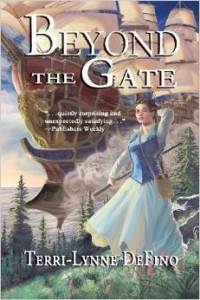
Beyond the Gate cover, by Jesse Smolover

There is my beautiful Linhare. A woman. On the cover. And you know what I discovered? The local bookstore that carries my books sells about four Beyond the Gate to every Finder or A Time Never Lived. Egads, indeed.

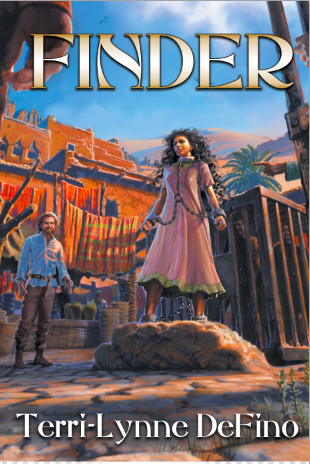
Eric and I decided to try an experiment. We contracted with our house artist, Tom Vandenberg, to do a new cover for Finder. During the process, Eric had a stroke. My cover kind of got lost in that chaotic shuffle. Running the press for Eric has been fulfilling, frustrating and extremely educational, but now that he’s recovering and able to take back some tasks, my cover came out of the closet. And here it is…

Finder cover art by Thomas Vandenberg

I am over the moon. I love this cover. I love Zihariel’s ferocity, even in chains. I love the “wormhole” view. Best of all, I love that I can keep both covers out in the world. The ebook and trade paperbacks will have the new cover, but my hardcover will keep the original art. Just seems fitting, to me.

At this writing, the new cover is only available on the ebook. There has been a glitch in the works concerning the print copy, but our fabulous cover designer, Heather McDougal, is traipsing about Italy at the moment, so it’s going to be another month or so before it’s available in print.

So–what do you think? I am interested to see if the new cover sparks sales, but mostly, I can’t wait to put both covers on a table at some convention somewhere, and see what happens.

14 Comments

Filed under Fantasy

Are You Trustworthy?

I love the ballet. I love dance, in general, but ballet? Sigh…when I was much younger, my mother used to buy me season tickets for the ABT at Lincoln Center every year for my birthday. Golden days! Life changed. I couldn’t get all the way into the City so often, and the ballet season started passing me by.
Years later, she surprised me with tickets to one of my favorite ballet’s–La Bayadère, not just for me, but for my two daughters. Being in Lincoln Center again was so thrilling, and now to share it with my girls? Magical. But I was older by then, my life far different from the youngster who used to simply watch in abject awe. My writer-brain was fully fleged by then, and I made some interesting connections.
During the second act of La Bayadère, the male and female principals went into a lift that boggled my brain. The ballerina was very slight. His legs were like treetrunks. The ease with which he lifted her was astounding enough; the way she held her pose, body arched, arms reaching, unmoving while he turned round once, twice, three times. It was fluid, graceful, effortless, or so it seemed. Of course, it wasn’t. Trust, the giving and the taking of it, made it seem so.The female principal is all about trusting, while the male principal is all about being trustworthy. The absolute confidence she has in his ability to hold her aloft, and later, leaping at him and knowing he is going to catch her is a beautiful thing. Without that trust and trustworthiness, the beauty of the dance loses the abandon. It becomes steps painstakingly taken. It loses the magic. Sitting there in the dark theater, in thrall of the dancers, the thought returned every time she leapt, he caught; he lifted, she posed. On the ride home was when it truly hit me.

Readers trust. Writers must be trustworthy. Readers want to move into our created worlds whether a galaxy far, far away, a dragon-infested castle, New York City circa 1935, or present day LA, and live there for a while. When they pick up our books, read the blurbs, buy them, they’re saying, “I trust you to deliver.”  We writers are often given only one chance to do so. If we don’t prove trustworthy, those readers aren’t going to trust us again.

It’s a big responsibility being that trustworthy. And it’s hard to consciously keep our readers in mind when we write. They are our stories, after all. But if you’re writing with the hopes of anyone other than yourself reading your work, whether published or not, you’re entering into that contract of trust.Is this scene important to the book? Or do I just really like it? Does the reader need this information? Or is it simply cool stuff I’ve researched/invented that I want to use? Is using the word epicrisis* really necessary, or do I simply want to utilize my vast vocabulary? 

We have to write what we love. We have to stay true to our voices, our styles, our tics. They make us the writers we are. We also have to do it in a way that’s going to appeal to someone outside of ourselves. Don’t slip in that random character cut from another story because you really like him and want to use him somewhere. Don’t drop adverbs into the story because they are easier. Don’t infodump those cool worldbuilding or historical facts you have filled countless notebooks with. And don’t use words your reader is going to have to stop and look up.
If a dancer drops his partner, she may leap again, but it’s not going to be with the same abandon. Likewise, if a reader picks up a book that is more about the author’s pleasures than the story itself, the trust is broken. It might take a while to lose a loyal fanbase, but once you lose a reader’s trust, it’s GONE.
*epicrisis~praising or disparaging by paraphrasing or citing somebody else. In case you were interested. And yes, I had to look it up.

15 Comments

Filed under Writing is Life

Guide to Writing Good*

Every writer, no matter what skill level they’re in, has writing advice to give. I see some very good advice, and I see some very bad advice. We take it or we leave it. Here is mine–the absolute authority on writing good*:

1.  The best way to open up a novel is with a stormy night. A dark one. You want to create drama and tension. How much more dramatic and tense can one get than a dark and stormy night? It’s just logic.

2. Write what you know. If you’re going to write about sky-diving, you’d best be prepared to jump out of a plane. No amount of research is going to give you the same experience. Hey, we’re supposed to be willing to die for our art. You’re no exception.

3. Show, don’t tell–bah, humbug! You have to tell your story, right? Sheesh! Just get it on the page; your reader isn’t going to notice anyway.

4. No matter how many times you’ve submitted your 1000 page novel to the same agent, remember the old adage: If at first you don’t succeed, try, try again! She probably doesn’t remember you from one submission to the next. One of these days she’s actually going to read your submission and know what a find she has on her hands.

5. There can never be enough description. Why would you simply write: Her hem caught on a nail as she hurried through the door? What color was that dress? Was there beading? Empire waist? Low cut? Was there a bustle? Embroidery? Was it silk brocade or plaid woolens? Buttons? How many? Get every detail of the dress!! And while you’re at it, describe the door, and the floor, and the sort of nail her hem caught on. And don’t forget to pepper a few adverbs into it, as well as a word or two your reader is going to have to look up later on. All these things show your reader just how much you know about fashion and cloth, doorways and nails. AND, it proves just how well you can put words together! Believe me, your readers will be impressed!

6. Address the reader once in a while, just so he doesn’t forget that you, the author, is actually telling the story she’s reading–otherwise she might forget about you altogether, and that’s not very fair.

7. Before you ever start writing your novel, make up a list of the many alternatives to “said.” Said gets boring! You need to shout, exclaim, cry, hiss, boom, retort, echo, rejoin, question and vociferate! You get extra agent/publisher points if you never use the same word twice.

8. Grammar is for the hoity-toity, not real writers. You gotta write the way you speak or no one’s gonna take you for serious.

9. Feedback. Many writers give over their finished drafts to beta readers (a practice I do not advise you engage in.) These beta readers, even friends, will feel they have to find something wrong; and they inevitably will. They’ll mark up your manuscript with their opinion and foolish notions of plot holes (which your novel simply does not have) and pacing and characterization, grammar mistakes (but I’ve already established who grammar is for, so…) Sure they’ll throw in a few nice things or a smiley face. But remember! No one knows your story the way you do. Stick to your guns, defend your baby fiercely, even if they all gang up on you by agreeing on things–gasp–wrong with your baby. Know that they’re just jealous of your work and will do anything to thwart your efforts of obtaining an agent or publisher before they do. Don’t let it happen to you!

10. Most importantly, don’t attempt to write when there are elephants in your living room. No matter how they promise not to make noise, they will. And, if left to their own devices, they’ll poop on your floor. Elephants are just like that.


*Just in case you haven’t gotten it yet, this is all tongue-in-cheek. Spoofish. Foolish. Fun.

9 Comments

Filed under Writing is Life

The Five Stages of Writerly Grief

Hope to raise a few grins with this one. 🙂

Stage 1: Denial
This story is awesome. My hipster ballerina who fights crime with her indestructable tutu and her magic finger is like no other heroine I’ve ever seen. Screw the sparkly vampires. THIS is going to be the next new thing! My crit group just doesn’t get me. And I just know that new chick is going to steal my idea. I’d better copyright this story pronto! I’m only getting rejected because I’m an unknown writer–but how can I become known if no one will give me a chance? The publishing industry is just so unfair. I’m going to play World of Warcraft.

Stage 2: Anger
Writing sucks. No one understands me. Why is he getting published when I can’t even get a decent rejection? My stuff is just as good. So my grammer isn’t always perfect? What the hell are agents and publishers looking for, anyway? A good story? Or good grammer!? My story is f**king amazing! It’s ridiculous that I can’t get anyone to work with me on this. Fine! When I finally do get published, I’m going to make sure all the idiots who rejected me know what they missed out on. They’ll be sorry, just like all those publishers in England are sorry they didn’t take Harry Potter! A couple hours of WoW will make me feel better.

Stage 3: Bargaining
Form rejections suck. If I can have one personalized rejection, I’ll write a new story. Just one. Is that so much to ask? I’ll tell you what I won’t do. I’m not going to write another new word until I sell my hipster ballerina story. Not one word, do you hear me? Why would I waste the time on something new if I can’t sell the old one? It’s just logic. And don’t start the, “why don’t you try revising” crap. This is what I wrote, the way I wrote it. It stays. I’ll be playing WoW until my demands are met.

Stage 4: Depression
I am never going to be published. Why do I even bother trying? The publishing world is against me. I don’t know the right people. Hell, who am I kidding? I suck. My story sucks. Any future story I write is going to suck even worse. I’m an embarrassment to the word writer. I can’t even claim to be a scribbler! Scribbling is too good for me. My toddler has better grammer. My dog barks better dialog than I can write. Why was I even born!? Oh, yeah…to play World of Warcraft.

Stage 5: Acceptance
I’m never going to be published if I don’t improve those things getting me rejected. I have to learn how to spell the word grammer–erm, grammar–before I can even hope to understand the many concepts that make the written language the thing of beauty I aspire to create. I have to write, and rewrite until my work is the best I can make it, and if it’s still not right, I have to do it again. I have to keep my mind and ears open, really listen to those who know more about the craft than I currently do. I have to believe in myself, my talents, my stories. I have to write what’s inside instead of trying to catch a wave, or start a new one. Most of all, I have to sit my ass down in a chair and write. THEN I can play WoW…just for a little while.

*Elisabeth Kübler-Ross introduced this model in her book, On Death and Dying, 1969.
Note–I have nothing against World of Warcraft. I’ve never played. In its place, you can insert ANY activity you do instead of using the time to write.

7 Comments

Filed under Writing is Life

Cheat-sheet to characterization

Characters, whether the novel itself is character or plot driven, are a book’s best assets. Through them, we see the story, the setting, the conflicts, the tragedies and the triumphs. Toned down to props or larger than life, characterization is crucial to any work of fiction.

There are many ways to draw effective characters. These are simply the most basic points.

1: Dialogue. Internal, external, dialogue is tied for the most important part of creating a character. Giving a character his own voice, a distinct, easily recognizable voice, is crucial. For example, same gist, worded differently:

“I didn’t do nothing! It was Jaybird what did it!”

-vs-

“I did no such thing, for pity’s sake. It must have been your no-account cousin, Jay.”

You get quite a different image for each, no? Simply by the way they speak.

2: Tied in with dialogue is how your character responds to situations. Is she given to fight? Or flight? Does your character speak out? Or speak when spoken to? Is he a clown in large gatherings, yet quiet in small groups? How a character behaves is as important as how a character speaks.

3: What is your character’s story? Character needs to grow out of a sense of place. Setting plays a huge role in Oliver Twist’s character. There are plenty of wretched orphans in literature, but where Oliver comes from creates who he is. Where do your characters come from? Rich or poor? Loved or abandoned? City or country? Knowing these things will give you insight to his dreams, her fears, and how they came to be dreams and fears. Your character’s story will tell you how she will react to the plot you throw at her.

4: Names. What you name your character will set a tone your reader may never be aware is being set. Does the name have a short sound? A hard sound? A long, luxurious sound? Does this sound work to cement your character’s traits, or contradict? For example: Giladriel is lovely, lyrical, cultured. The sound of her name fits her character. Frodo is a Hobbit–sturdy, practical, short and to the point. Yup, fits the name. But what if the character of Giladriel was instead called, Gertrude? And what if Frodo Baggins was Beauregard Gardersmythe? See what I mean? Whether you name your characters appropriately, ironically, purposely contradictive, even invisibly, know why you’ve named your character as you have. You will know more about your character, and be better able to show that to the reader.

5: Description (IMO, the least important part of characterization.) We need a few details of what the character looks like–blond, short, stocky, a wonky eye. Unless their physical appearance lends something to the story, keep them as nondescript as possible. Captain Hook’s hook is part of the story, part of his character, but the exact shade of his eyes really isn’t.

Each one of these simple steps will lead you into another, more subtle aspect of characterization. Just remember–writers, can never know too much about their character; a reader can. As much as you love knowing that your character got her first kiss after rolling down a hill with her best friend, if it doesn’t pertain to the plot, your reader isn’t going to miss it.

13 Comments

Filed under Writing is Life